Restaurant joinery Dubai: scope, materials and real costs
Restaurant joinery in Dubai covers every fixed element built from timber, board and solid surface, from the bar front guests lean on to the back counter staff work behind. Here is the real scope, the materials that survive grease and humidity, and what the work costs in AED.
Why work with Malak Afzal
- Dubai based fit-out and joinery contractor
- In-house joinery production plus site installation
- Interior fit-out, bespoke joinery and custom furniture from one team
- Mosques, offices, clinics, retail, hospitality and residential interiors
- Google rating 4.8 from 27 reviews
- Direct line to the project team on +971 55 131 7286
What restaurant joinery covers in a Dubai restaurant or cafe
The joinery package is everything fixed that is built from timber, board or solid surface, sitting between the shell of the unit and the loose furniture. In a full restaurant it usually runs from the bar to the washroom.
- Bar front and foot rail: dressed front panels, stainless kick plate, concealed LED, under bar shelving
- Bar top: solid surface or timber with sealed joints and a drip groove
- Back counter: base units, stainless worktop, overhead glass racks, lockable storage
- Banquette and booth seating: fixed plinths, foam, contract upholstery, timber backs
- Host desk: cable management, menu storage, stone or solid surface top
- Wall panelling and ceiling features: timber slats, veneer panels, screens, acoustic backing
- Service stations: waste drop, cutlery drawers, hand sink surround, hot water point
- Washroom vanities and mirror surrounds, where the operator wants matching trim
In a smaller cafe joinery Dubai scope, that list shrinks to a service counter, a pastry display surround and 12 to 18 seats. On larger F&B joinery Dubai projects it grows to include private dining partitions and a separate delivery pickup counter. Either way the rules are the same: every surface has to take daily cleaning chemicals, and every unit has to be serviceable without being dismantled.
If you are structuring a package, our office joinery scope, materials and real costs breaks the same elements down for commercial interiors.
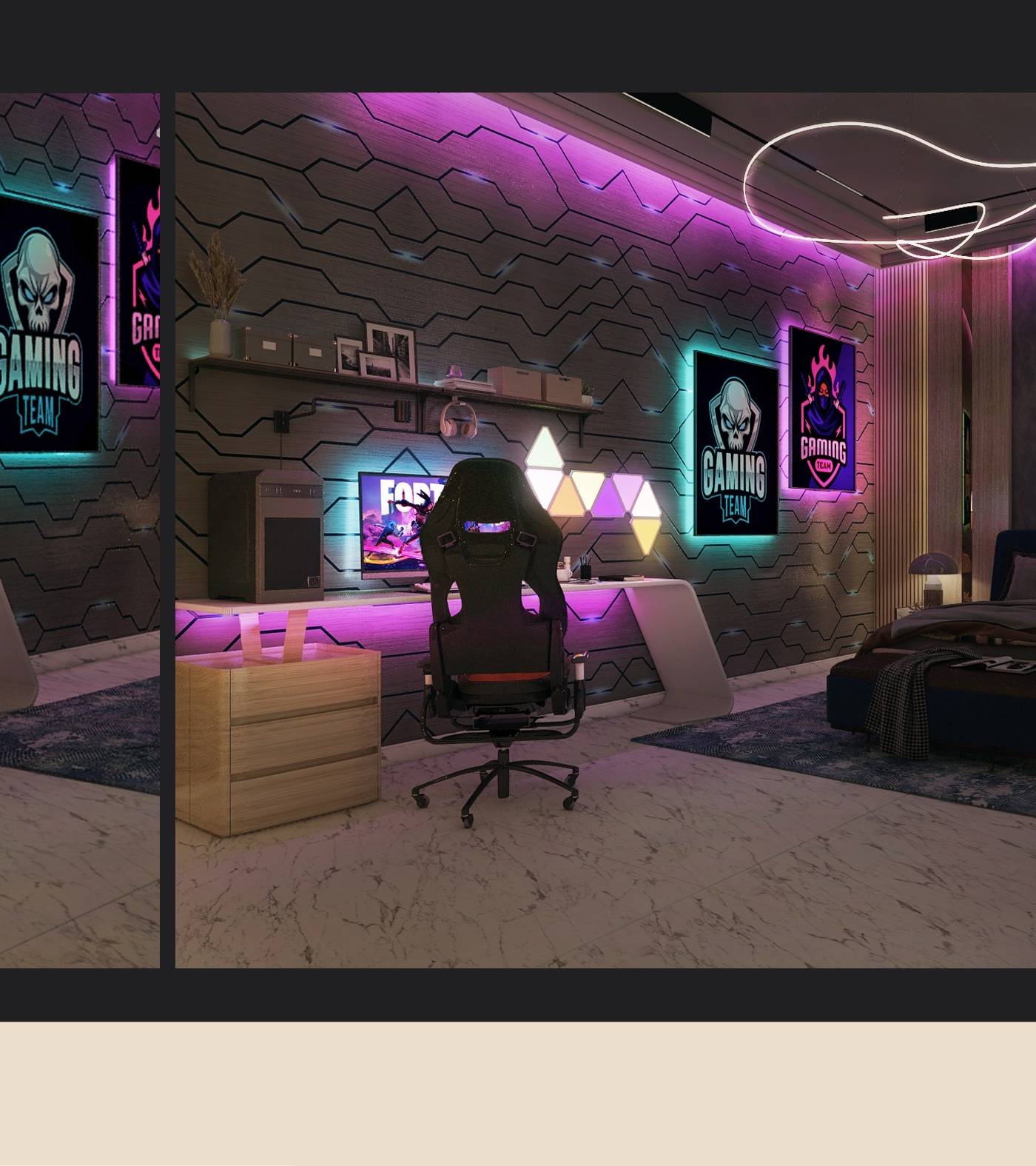 A 3D render like this is how finishes and lighting get approved before any joinery goes to production.
Materials that survive grease, heat and humidity
The decision in Dubai is rarely about colour. It is about how a surface behaves after a year of steam, oil and 45C afternoons.
- HPL on a moisture resistant MDF core for bar fronts, back counters and general casework. Lowest cost per square metre, wipeable, and easy to swap one panel.
- Stainless steel grade 304 for worktops, splashbacks, kick plates and anything within reach of a fryer or dishwash.
- Solid surface for bar tops and counters. Seams sand flush and scratches polish out on site.
- Marine ply or moisture resistant MDF for carcasses near ice wells and wash up. Standard MDF swells once water reaches the core.
- 2mm ABS or PU edge banding on every exposed edge, with silicone sealing at wall and floor junctions.
- Contract upholstery rated 30,000 rubs or higher on closed cell foam, so spills do not soak into the seat.
- Stainless or powder coated aluminium plinths to lift timber clear of wet floors.
Avoid timber within 100mm of a cooking line. Where a design wants a timber soffit over the pass, use fire retardant treated board and keep the clearance the suppression system needs.
DET, Dubai Municipality, DEWA and civil defence rules that shape the joinery
Joinery should go to production only after the food premises layout is approved, because that approval fixes where counters, sinks and staff routes sit.
- Dubai Municipality food premises rules set the surface standard: non porous, washable, light coloured finishes in prep and wash up zones, with coved junctions at wall and floor.
- DET approval covers the trade licence and fit-out permit for the unit, including the layout drawing the joinery has to follow.
- DEWA connected kitchen services need isolation points, meters and shut off valves left accessible, so joinery around them needs removable access panels rather than sealed boxes.
- Civil defence clearance for cooking lines covers hoods, suppression and duct routes. Joinery has to hold the clearance and allow duct cleaning access.
- Moving a counter after approval usually needs a revised submission, which is why the joinery layout is locked before board is cut.
Restaurant joinery cost Dubai: real AED figures
Expect the F&B joinery package to land between 12 and 18 percent of the total fit-out budget on a mid size restaurant. Unit rates are the fastest way to test a quotation.
- Bar counter joinery Dubai rates: AED 1,900 to AED 3,200 per linear metre for a dressed front in veneer or HPL with stainless kick and concealed LED
- Bar top: AED 1,200 to AED 2,800 per linear metre, depending on solid surface thickness and edge profile
- Back counter: AED 2,400 to AED 4,500 per linear metre, including stainless worktop, under bench storage and overhead shelving
- Banquette seating Dubai: AED 1,100 to AED 1,900 per seat with plinth, foam and contract upholstery
- Booth seating: AED 2,800 to AED 4,200 per four seat booth with timber back and privacy panel
- Host desk: AED 4,500 to AED 12,000 per unit
- Wall panelling: AED 350 to AED 950 per square metre fitted
- Service station: AED 6,000 to AED 15,000 per unit
Worked example. A 160 sq m restaurant with a 6 linear metre bar front, 40 fixed banquette seats, 7 linear metres of back counter, one host desk and 40 sq m of panelling.
- Bar front, 6m at AED 2,400 = AED 14,400
- Bar top, 6m at AED 1,800 = AED 10,800
- Back counter, 7m at AED 3,100 = AED 21,700
- Banquette seating, 40 seats at AED 1,400 = AED 56,000
- Host desk = AED 7,000
- Wall panelling, 40 sq m at AED 600 = AED 24,000
That is AED 133,900 for the joinery package, or roughly AED 140,600 with 5 percent VAT. It excludes MEP, kitchen equipment, flooring, ceilings and painting. A mall unit usually adds landlord conditions such as night shift work and protective sheeting, while a street front unit has simpler access but more civil defence work around the cooking line. Send your layout through and get a restaurant joinery quote.
Their team is professional, creative, and highly committed to delivering quality work. Haidar Ali Khan, 5/5 on Google
Shukran Interiors & Building Contracting LLC holds a Google rating of 4.8 from 27 reviews.
How joinery is sequenced around MEP and kitchen equipment
Joinery installs last but has to be measured first, so the programme works backwards from the kitchen equipment landing date.
- Site survey and shop drawings, around 2 weeks. Measure after MEP first fix so every socket, drain and gas point is confirmed.
- Finish approval, 3 to 5 days. Samples for bar top, veneer or HPL, upholstery and edge detail.
- Workshop production, 3 to 4 weeks. Service holes and cut outs are done at the bench, not on site.
- MEP second fix and ceiling, coordinated. Closed units go in only after electrics and plumbing are signed off.
- Kitchen equipment landing, checked against the actual unit. Back counter dimensions follow delivered equipment, not the spec sheet.
- Joinery installation, 2 to 3 weeks. Bar first, back counter second, banquettes and panelling last so other trades cannot damage them.
- Tops, upholstery and sealing, 3 to 5 days. Solid surface tops are templated after carcasses are fixed, never before.
- Snagging and handover.
From approved drawings, allow 6 to 9 weeks. Mall units add a week or two because most of the work happens in night shifts.
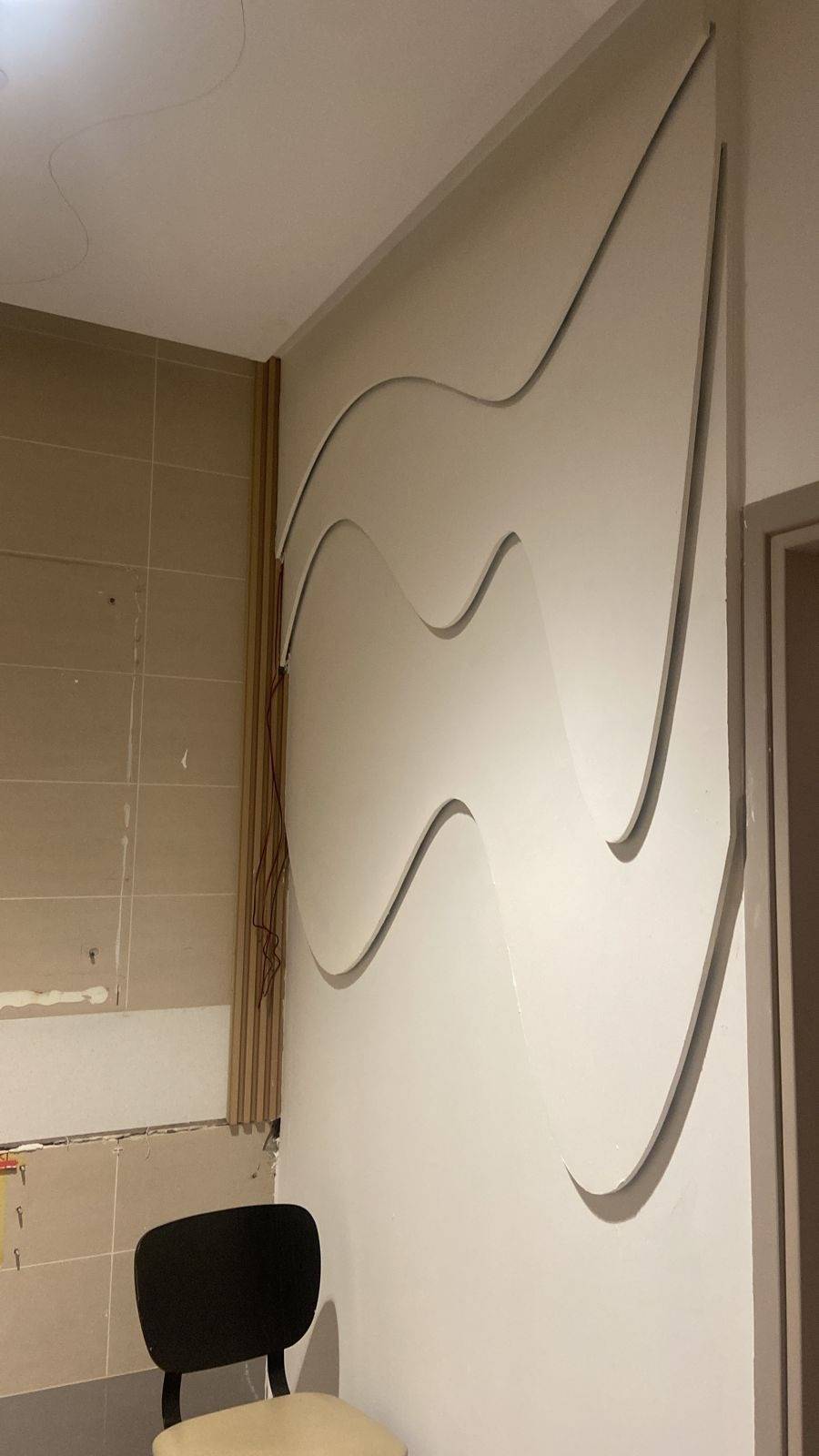 Feature wall panelling mid install, slats set out and levelled before the finishing coat goes on.
Refurbishment, snag lists and handover
Worn F&B joinery in Dubai usually fails in three places: the bar top edge, the front lip of the banquette and the base of the back counter. Those are also the cheapest items to put right.
Re-polishing solid surface, replacing stainless kick plates, re-facing bar fronts and re-upholstering banquettes can be done in two or three night shifts so the venue keeps trading. A typical refresh of a 6 linear metre bar front plus 30 banquette seats runs AED 45,000 to AED 65,000. Full replacement only makes sense when carcasses have swollen from water ingress.
Handover checklist:
- Every door and drawer runs without rubbing, soft close tested
- Solid surface joints sanded flush, no visible glue line
- Silicone at wall and floor junctions continuous and tooled
- Service cut outs line up with sockets, drains and valves, access panels lift out by hand
- Kick plates and plinths sealed, no open gaps in wet zones
- Upholstery seams straight, foam not compressed at corners
- Stainless free of scratches, protective film removed
- Spare laminate, two spare hinges and a touch up kit left on site
More build breakdowns like this sit in our commercial fit-out and joinery articles.
Frequently asked questions
How much does restaurant joinery cost in Dubai?
A mid size restaurant joinery package usually runs AED 120,000 to AED 260,000, or 12 to 18 percent of the total fit-out budget. Unit rates are easier to plan with: bar fronts AED 1,900 to AED 3,200 per linear metre, banquette seating AED 1,100 to AED 1,900 per seat, back counters AED 2,400 to AED 4,500 per linear metre. Those figures exclude VAT, MEP and kitchen equipment.
How long does restaurant joinery take from drawings to handover?
Allow 6 to 9 weeks. Shop drawings take about two weeks, workshop production three to four weeks, and installation two to three weeks, with tops and upholstery finished in the last few days. That timeline holds only if MEP first fix is complete before closed units are installed.
Do I need DET or Dubai Municipality approval before joinery is built?
Yes. The food premises layout has to be approved first, because it fixes counter positions, sink locations and surface requirements. Civil defence clearance for the cooking line also affects how joinery is built around hoods and ducts. Building before approval normally means rework.
Can you match existing joinery when refurbishing a bar counter?
Usually yes. Bar fronts can be re-faced in matching HPL or veneer, solid surface tops can be sanded and re-polished, and stainless can be replaced in the same gauge. If the original material is discontinued, re-facing the whole front is often cheaper than matching one damaged section.
Do you supply banquette seating and upholstery as part of the joinery package?
Yes. Fixed banquettes, booths and loose seating are built in-house with closed cell foam and contract fabric or vinyl rated at 30,000 rubs or higher. Upholstery is fitted after the plinth is level and walls are sealed, so cushions sit square. Replacement covers can be remade later from the same template.